TikTok Content Posting API approval can turn a denied submission into a production-ready integration when every scope, domain, and demo is documented clearly.
TikTok Content Posting API Approved: A 5-Scope Case Study
The TikTok Content Posting API was approved for a client app after an initial denial — unlocking direct video publishing alongside 3 already-approved profile scopes, for a StackPosts-based social media scheduling SaaS. This case study covers exactly what TikTok required, why the first Content Posting API request was denied, and what changed in the resubmission.
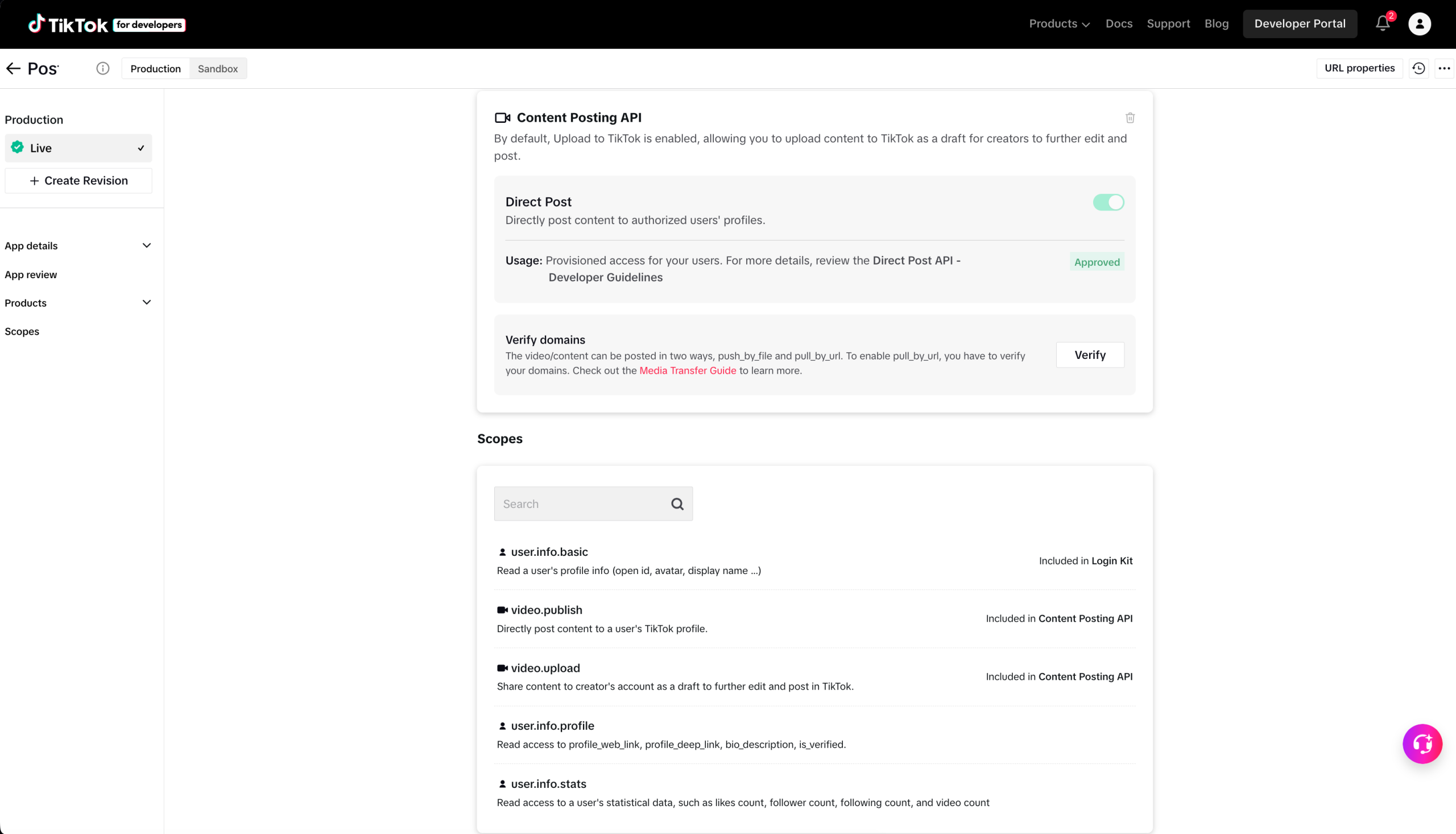
The app is now live in production with all 5 requested scopes approved: 3 under TikTok's Login Kit and 2 under the Content Posting API.
TikTok Content Posting API approval: what was approved
Login Kit scopes
user.info.basic, user.info.profile, and user.info.stats — reading a connected user's basic profile info and stats.
Content Posting API scopes
video.publish and video.upload — publishing and uploading video content directly to a user's TikTok profile from inside the app.
Outcome
TikTok Content Posting API approved on resubmission, Direct Post enabled, domain verified, all 5 scopes live in production.
Why This Needed Two Separate Applications
The app already had a working TikTok Login Kit integration with user.info.basic live, but the additional scopes it requested were disapproved. The reason wasn't a weak use case — it was a structural mismatch. video.publish and video.upload are not part of TikTok's Login Kit scope list at all; they only become available once an app is separately approved for the TikTok Content Posting API, which has its own application form, its own review, and its own requirements beyond basic OAuth scopes.
This is the single most common point of confusion for apps adding TikTok publishing: requesting video.publish as if it were just another Login Kit scope, instead of applying for Content Posting API access first.
What the Content Posting API Application Requires
Once the Content Posting API application was identified as the real next step, several things had to be in place before TikTok would approve it:
Domain verification
TikTok requires the app's domain to be verified before pull_by_url content delivery is enabled for Direct Post — without it, part of the publishing flow simply isn't available.
TikTok-specific privacy and terms language
The app's live Privacy Policy and Terms of Service pages had to explicitly describe how TikTok user data and published content are handled, stored, and controlled by the user.
A detailed, specific use case
The application had to explain exactly how users connect their own TikTok account through OAuth, create or select their content, and explicitly choose to publish — with the platform never posting without direct user authorization.
A justified usage estimate
TikTok asks for an estimated daily active user range for the Content Posting API and an explanation of how that number was reached — a guess without justification is a weak point in the application.
The exact API response fields stored
TikTok wants to know precisely which response fields the app saves — in this case post ID, publish ID, upload status, processing status, error codes and messages, published video ID, and publishing result status.
A real demo video of the live flow
The screencast had to show the actual, current publishing flow inside the app rather than an old or generic recording — TikTok checks that the demo matches what real users see.
The First Content Posting API Request Was Denied
The first Content Posting API application came back denied. Rather than resubmitting the same form with small edits, the rejection was diagnosed against TikTok's actual requirements above — domain verification was confirmed, the privacy and terms pages were checked line by line, the use case description was rewritten to be specific about user authorization and control, and a fresh demo video was recorded matching the live app. The resubmission was approved.
The Result
TikTok Content Posting API approved on resubmission, Direct Post enabled, domain verified. All 5 scopes now live in production.
Common Reasons TikTok Content Posting API Requests Get Denied
See TikTok's own Content Posting API documentation for the official requirements. If your app is built on a platform like StackPosts or ChatPion and is running into the same wall adding TikTok publishing, our related case studies on 17 Meta permissions approved for a ChatPion chatbot, why chatbot and automation SaaS tools get rejected or restricted, and two rejections, then approved cover the same rejection-to-approval pattern on other platforms.
Results shown are from a real, completed TikTok API approval project. TikTok makes the final review decision on every submission — the work here is thorough preparation and accurate application documentation, not a guaranteed outcome.
For TikTok Content Posting API approval, map every requested scope to one visible product workflow.
TikTok Content Posting API review is stronger when the use case, privacy policy, and terms language match the submitted application.
Document TikTok Content Posting API data handling before reviewers ask how response fields are stored.
Show TikTok Content Posting API upload behavior with a real demo that matches the production flow.
Estimate TikTok Content Posting API usage honestly instead of requesting unexplained high volume.
Keep TikTok Content Posting API redirects, domains, and login configuration consistent across environments.
After TikTok Content Posting API approval, monitor scope changes and review requirements before releasing new features.
Use TikTok Content Posting API documentation to prepare a precise response when an initial submission is denied.
Need Us to Get Your TikTok API 100% Approved?
Stop losing weeks to TikTok app audits and scope review rejections. With 500+ apps approved, we handle your entire submission from start to finish. You get 100% Approval or a 100% Refund — and for your complete safety, you can hire us directly through Upwork or Fiverr Escrow (or use the WhatsApp / Calendar buttons in the header & footer).
Chat on WhatsAppFrequently Asked Questions about TikTok Content Posting API approval
Why does TikTok reject Content Posting API apps?
TikTok usually rejects apps when the demo video doesn't show the full posting flow with required user controls, the app's website or privacy policy is incomplete, or scopes are requested that the app doesn't visibly use.
How long does TikTok Content Posting API approval usually take?
It usually takes ~2–3 days for preparation and submission, followed by the platform's review queue — typically 7–15 days (often faster on platforms like X, or longer depending on platform review volume and any follow-up rounds).
Is there a guarantee?
We work on a 100% Approval or 100% Refund basis: if we can't get your valid use case approved, you get a full refund.
How can I hire you safely?
You can hire us through Upwork or Fiverr, so your payment stays in Escrow and is only released when the work is delivered. We've been doing this for 10+ years, with 500+ apps approved and 10,000+ permissions granted.