ChatPion App Review Guide: Permissions, VPS Webhooks & Rejection Patterns
A ChatPion app review (Meta Advanced Access for your ChatPion install) is rarely a single-permission problem. ChatPion is a white-label Messenger / Instagram chatbot and automation SaaS. Going live for real customers usually means Advanced Access across Pages, Messenger, Instagram, and Business Manager scopes — plus a VPS callback URL Meta can actually reach. This ChatPion app review guide diagnoses why submissions fail in the field: permission bundle weight, webhook/HTTPS gaps, reviewer recreateability, Business Manager mismatches, and cooldown risk from blind resubmits. It is not a pasteable DIY approval recipe.
WHAT breaks
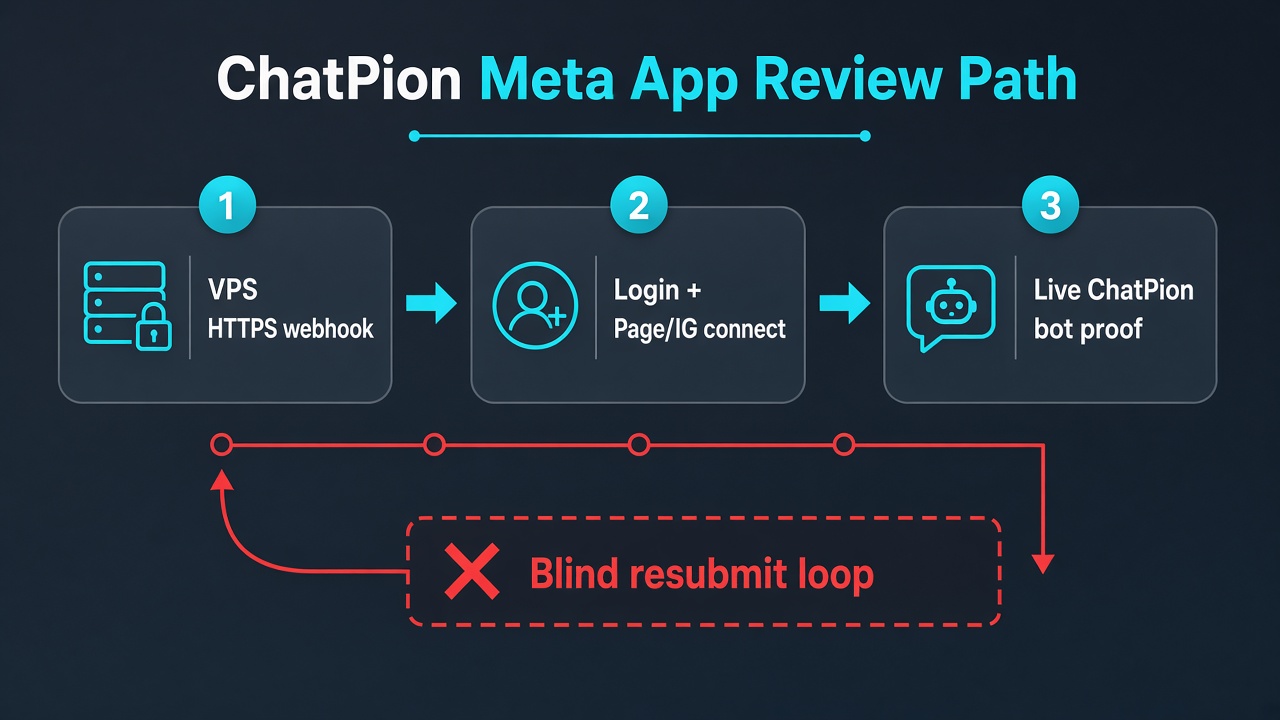
ChatPion “works for admin” while reviewers cannot recreate Login → Page/IG connect → bot reply or publish proof for each requested scope.
WHY ChatPion is heavy
One install often requests a wide Advanced Access set. One weak permission can drag the whole ChatPion submission down.
WHAT Meta expects
Live, recreateable flows for every Advanced Access item — not only a pretty ChatPion dashboard screencast.
What ChatPion typically needs from Meta
Exact scopes depend on which ChatPion modules you enable (Messenger bot, Instagram automation, comment tools, content publish, e-commerce in chat). In real ChatPion Meta App Review packages we see stacks that commonly include combinations of:
pages_messaging— Page Messenger conversations (often withpages_manage_metadataandpages_show_list)instagram_manage_messages— Instagram messaging on the Facebook Login path (distinct from Instagram Login’sinstagram_business_manage_messages)instagram_basic,instagram_manage_comments,instagram_content_publish— profile, comments, and publishing modules when those ChatPion features are onpages_manage_posts,pages_manage_engagement,pages_read_engagement,pages_read_user_content— Page content and engagement surfacesbusiness_management— Business Manager / asset access patterns many multi-tenant ChatPion setups touch- Insights / locale-style helpers when the script’s analytics or audience features actually call them
Treat this as a diagnostic map, not a mandatory shopping list. Requesting every ChatPion checkbox “just in case” is a common rejection amplifier. Deep diagnosis for individual hard scopes lives in the Category A line: pages_messaging, instagram_manage_messages, and business_management.
VPS, HTTPS callback, and ChatPion webhooks
ChatPion is installed on your server. Meta App Review does not care that your cron is green if the reviewer cannot hit a stable HTTPS endpoint. Typical ChatPion webhook / callback failures that look like “permission” rejections:
- HTTP or self-signed TLS — Meta webhook verification and Live mode expect valid public HTTPS.
- Wrong callback path — ChatPion’s Facebook / Instagram webhook URL in the app dashboard does not match the live route on the VPS (nginx rewrite, folder install, or missing
index.phppath). - Firewall / IP blocks — hosting panels that drop Meta’s verification requests after ChatPion “saved” the URL.
- Staging-only domains — screencast uses production, credentials open a staging app with a different App ID or callback.
- Subscription gaps —
pages_manage_metadatastory claims webhooks, but subscribed fields never fire when the reviewer sends a test message.
If inbound ChatPion bot replies only work on your laptop session, App Review will treat messaging scopes as unverified even when the use-case essay is perfect. Fix reachability before rewriting permission notes.
Why ChatPion Meta App Review gets rejected
Patterns we see repeatedly on ChatPion App Review (and similar chatbot SaaS scripts):
- Bundle without per-scope proof — one long video of the ChatPion UI while Meta still judges each Advanced Access item. A missing Instagram DM send recording can sink messaging even if Messenger looked fine.
- Template use-case text — notes copied from another ChatPion seller that do not match your enabled modules or Privacy Policy.
- Admin-only success — roles/dev users can chat; Test User / reviewer credentials never connect a Page or IG professional account ChatPion can drive.
- Business Manager / verification mismatch — app under a BM that cannot support the access level you requested; owners discover this only after rejection.
- Login family confusion — ChatPion Facebook Login Instagram messaging vs Instagram Login permission names mixed in the submission.
- Screenshot theater — stills of an inbox while Meta’s messaging tables ask for recordings of send/delivery for several scopes.
Banner labels vary (“unable to verify the permission(s) requested,” “inadequate demonstration,” “unable to approve permission request”). Map the banner to missing recreateable ChatPion proof — not to a luckier resubmit day. Related rejection framing: Unable to Verify Permissions and Inadequate Demonstration.
Multi-permission ChatPion submissions (field reality)
Chatbot SaaS platforms like ChatPion are among the heavier App Review cases because reviewers must see each requested Advanced Access path. In one published ChatPion case, a full messenger + Instagram + commerce style stack required a large permission set prepared together — messaging, Page management, Instagram, and Business surfaces — because dependencies are tested as a story, not as isolated checkboxes. That does not mean every ChatPion install should request seventeen scopes. It means: enable only what your live ChatPion build uses, then make that smaller set recreateable.
If one module is half-finished (for example Instagram comment automation unfinished while Messenger works), drop or defer that scope instead of hoping Meta will “approve the good parts.” Partial product truth beats a maximal ChatPion feature list.
Common ChatPion demo gaps (diagnosis, not secret sauce)
- Reviewer instructions that assume the tester already knows ChatPion menu paths.
- Test Page / IG account not granted to the credentials you supplied.
- Webhook green in ChatPion settings but no inbound event when the reviewer messages the Page.
- Screencast jumps past Facebook Login / Page grant straight into a pre-seeded bot inbox.
- Privacy Policy / data deletion URL on a different domain than the ChatPion app domain Meta sees.
These are categories of failure. Token models, multi-tenant ChatPion white-labels, and hosting stacks differ — copying another agency’s screencast usually creates a new mismatch.
ChatPion is an inbox/bot stack. Scheduler scripts fail on a different axis (OAuth + cron publish) — see the Stackposts app review guide when the product is a calendar, not a chatbot. For a sister multi-channel bot script, use the BotSailor app review guide instead of stretching ChatPion notes across every Meta module.
7-day cooldown risk: Blind ChatPion resubmits — new essay, same broken callback, same unrecreateable Instagram path — often fail again and can lock App Review controls for about seven days. Use the pause to fix VPS reachability and scope honesty, not to spam Meta.
When a ChatPion specialist audit helps
Useful after one or two ChatPion app review rejections when the script “works for you” but Live users still cannot run. The audit maps rejection language to evidence gaps: webhook HTTPS, Login/Page/IG connect, which ChatPion modules actually need Advanced Access, and whether Business Verification / Tech Provider paths are blocking before content is judged.
Not useful if you only want a guaranteed one-size ChatPion recording or a list of every possible Meta permission. Over-requesting increases failure surface. For a proof-of-work narrative on a completed ChatPion stack, see the ChatPion 17-permissions case study. For hands-on installation + approval service framing, see ChatPion App Approval.
Need Us to Get Your Meta App 100% Approved?
Stop losing weeks to repeated rejections. With 500+ apps approved, we handle your entire submission from start to finish. You get 100% Approval or a 100% Refund — and for your complete safety, you can hire us directly through Upwork or Fiverr Escrow (or use the WhatsApp / Calendar buttons in the header & footer).
Chat on WhatsAppFAQ
What is a ChatPion app review?
It is Meta’s Advanced Access review for the Facebook app powering your ChatPion install — typically Messenger, Instagram, Page, and Business scopes your enabled modules call — not ChatPion’s own license check.
Why does ChatPion work for admin but fail App Review?
Admin/dev roles bypass Advanced Access. Reviewers need external credentials, working HTTPS webhooks, and visible bot or publish actions without insider shortcuts.
Do I need every ChatPion permission at once?
No. Request only scopes tied to live ChatPion modules you can demonstrate. Unused Instagram or ads-adjacent scopes often weaken the whole ChatPion submission.
Can ChatPion webhook issues look like permission rejection?
Yes. If Meta cannot deliver events to your VPS callback, messaging and metadata permissions appear “unverifiable” even when ChatPion’s UI looks correct.