Facebook Login embedded webview rejection: When Meta App Review returns Your app is embedding the Facebook Login dialog inside a custom web view, the rejection is about OAuth security and user experience — not button styling. Mobile in-app web views cannot share cookies with the system browser, which creates a poor Login experience Meta explicitly rejects. This article explains the Rejection Guide, Login Best Practices, Custom Tabs, cooldown risks, and when an audit is safer.
Facebook Login Embedded WebView Rejection: What This Means
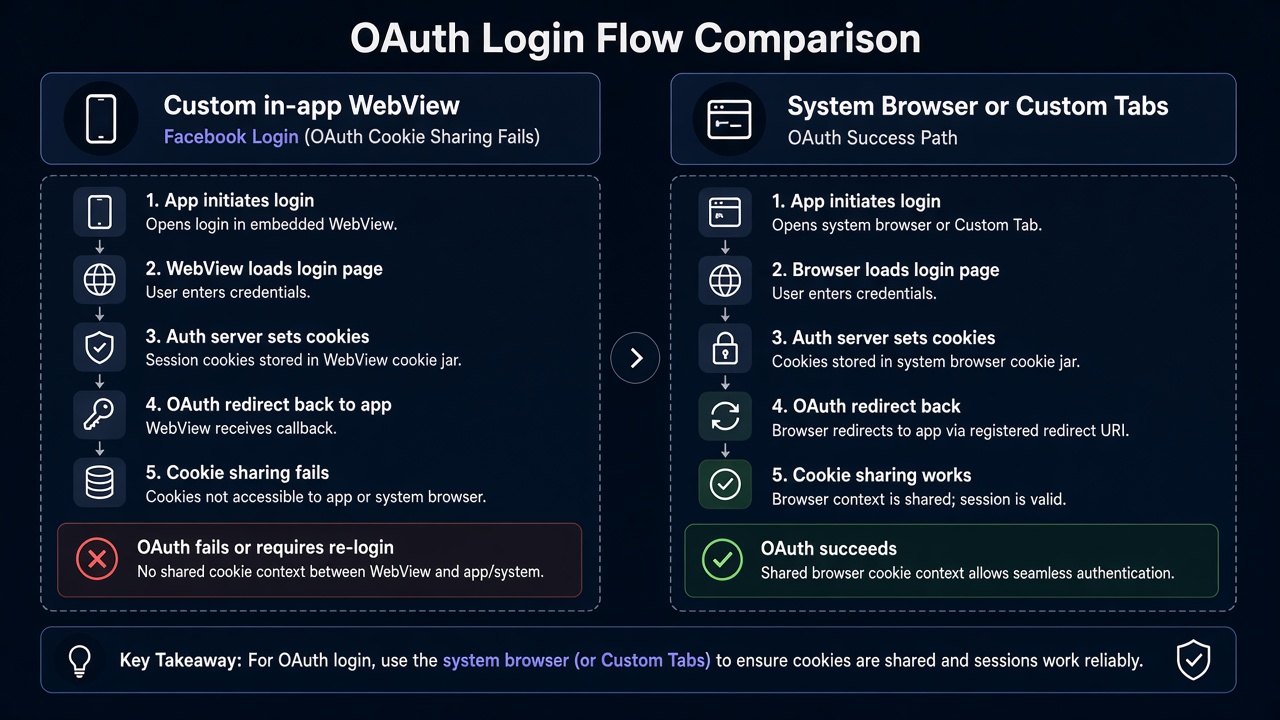
Meta’s App Review Rejection Guide is direct: submissions for mobile apps that display Facebook Login within in-app web views will be rejected. In-app web views cannot share cookies with the system browser, which results in a poor user experience.
Official remediation is to refer to Facebook Login Best Practices and fix functionality that produces a poor experience before resubmitting. This is not a request for prettier WebView chrome; stop hosting the Facebook Login dialog inside a private embedded browser surface.
Best Practices reinforce the same rule under “Avoid in-app web views.” Users otherwise see full username and password prompts or cookie consent banners instead of a trusted system Login experience.
WHAT FAILED
Reviewers observed Facebook Login running inside a custom in-app web view rather than a supported system or external browser path.
WHY IT MATTERS
Embedded browsers break cookie sharing, degrade trust signals, and increase phishing risk on Android login surfaces.
WHAT THEY EXPECTED
Native SDK flows, Facebook app switch, Chrome Custom Tabs or system browser on Android, and ASWebAuthenticationSession-class paths on iOS.
Reviewer psychology: security theater fails instantly
App Review will not approve “our WebView is sandboxed and fine.” Once Login renders inside a custom web view, the policy outcome is rejection. Notes arguing that users prefer staying in-app rarely override documented Best Practices.
If an auth broker or white-label shell wraps every OAuth provider in the same WebView, Facebook Login can fail review even when Google or Apple flows work. Ambiguity defaults to embedded-browser rejection.
Facebook Login Embedded Technical Nuances: OAuth Security and Mandatory External Browser
Across hundreds of Meta apps, the same embedded-browser patterns trigger this label:
- Android WebView Login — loading Facebook OAuth in WebView or forcing
LoginBehavior.WEB_VIEW_ONLY. - Outdated SDK — older SDKs that do not prefer Custom Tabs or modern system auth sessions.
- iOS WKWebView shells — hosting Login inside an in-app browser instead of ASWebAuthenticationSession.
- Hybrid WebView wrappers — Cordova, Flutter, or React Native shells that never open a full-screen system prompt.
- Cookie isolation symptoms — password entry, cookie banners, or non-fullscreen Login experiences.
- Embedded browser OAuth left on — a dashboard toggle alone does not fix a WebView UI.
Meta’s Login Security documentation discusses disabling unused OAuth flows, including embedded browser OAuth, to reduce attack surface. Facebook Login belongs in supported system or external browser and native SDK channels, not a private custom web view.
Official references: Meta App Review Rejection Guide, Facebook Login Best Practices, Facebook Login Security, and Meta Developer Policies.
Blind resubmission risk: Rapid resubmits using the same WebView shell, WEB_VIEW_ONLY override, or hybrid auth broker can trigger automated submission cooldowns. Those locks can disable review buttons for up to 7 days. Volume without removing embedded Login wastes calendar time.
Expert Diagnosis framework: not a DIY paste template
Every mobile stack’s embedded Login path is unique: native SDK overrides, React Native bridges, or third-party auth SDKs. Diagnose first rather than applying a one-size code paste.
Confirm where the Login dialog renders
Instrument a cold login on iOS and Android. In-app browser chrome, cookie banners, or non-fullscreen dialogs mean custom web view territory.
Remove forced embedded behaviors
Drop WEB_VIEW_ONLY overrides, update to a current Facebook SDK, and prefer Custom Tabs or system auth sessions.
Re-prove Login with a test user
Show the system prompt, Custom Tabs, or native switch path clearly so reviewers are not looking at a private WebView shell.
Resubmit once on the supported auth surface
One coherent non-embedded Login package beats three frantic wrapper tweaks. Cooldowns punish volume.
Also see broken Login button, unable to locate Login, app not loading, Facebook App Review service, and case studies.
Free 15-Minute Meta Rejection Audit
Share your rejection note, iOS or Android stack, and whether Login opens in a WebView. We will diagnose a forced WEB_VIEW_ONLY path, outdated SDK, hybrid auth wrapper, or wrong screencast surface.
Strategy second.
What not to do after this rejection
- Do not resubmit the same custom WebView Login with a longer justification note.
- Do not force WEB_VIEW_ONLY across social providers.
- Do not downgrade SDK versions to restore embedded browser behavior.
- Do not hide in-app browser chrome in a screencast.
Move Facebook Login to a supported system or external browser path. Prove it. Then submit once. Anything else gambles with cooldown risk.
Need Us to Get Your Meta App 100% Approved?
Stop losing weeks to repeated rejections. With 500+ apps approved, we handle your entire submission from start to finish. You get 100% Approval or a 100% Refund — and for your complete safety, you can hire us directly through Upwork or Fiverr Escrow (or use the WhatsApp / Calendar buttons in the header & footer).
Chat on WhatsAppFAQ
Why does Meta reject Facebook Login embedded in custom web views?
Per the Rejection Guide, in-app web views cannot share cookies with the system browser, which results in a poor user experience. Best Practices explicitly advise avoiding in-app web views.
Is Chrome Custom Tabs an embedded web view?
Best Practices recommend Chrome Custom Tabs on Android or the native Facebook app as alternatives to in-app web views. Custom Tabs participate in the system browser cookie context unlike a private app WebView.
Will only updating the screencast fix this?
No. Reviewers test the live mobile app. If Login still opens in a custom web view, a cleaner video of the same violation still fails.
Can rapid resubmits lock App Review?
Yes. Rapid retries without removing embedded Login can trigger automated cooldowns that lock review controls for up to 7 days.
Amandeep Singh — Meta API Expert
10+ years helping product teams through Meta App Review, Business Verification, and Advanced Access. 500+ apps guided; 10,000+ permissions handled across Facebook, Instagram, WhatsApp, and Marketing API surfaces. Focus: policy-aligned proof, not hype.
Still stuck on Facebook Login embedded in a custom web view? Get a focused read on your rejection before the next submit.
Book Free 15-Minute Meta Rejection Audit on WhatsApp