pages_read_user_content Approved: A 13-Permission Meta Renewal Case Study
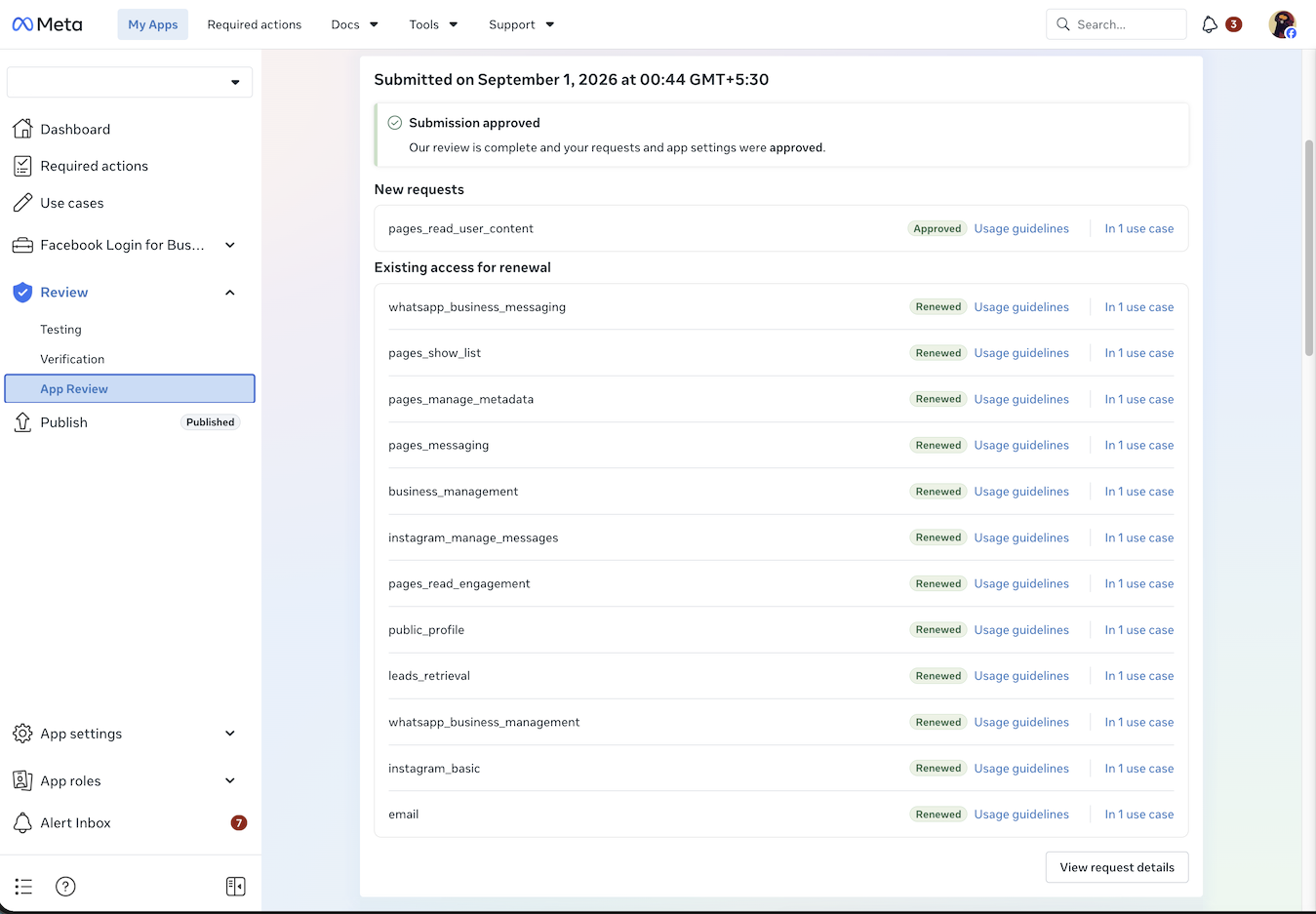
pages_read_user_content was just approved for a client app in the same Meta App Review submission that renewed 12 permissions the app already had in production. This case study walks through exactly what was submitted, why permission renewals are just as strict as a first-time review, and what pages_read_user_content is actually used for.
On September 1, 2026, Meta approved the entire submission in a single review pass — the new pages_read_user_content request and every one of the 12 renewals, with zero permissions lost.
What Was Submitted
New permission requested
pages_read_user_content — needed to read content that other people post on the client's Facebook Pages, for a moderation and reporting feature in the app.
Existing access up for renewal
12 permissions already in production had to be re-justified in the same cycle, covering Page management, Messenger, WhatsApp, Instagram, and lead data.
Outcome
Submission approved — the new pages_read_user_content request approved, all 12 renewals approved, no access lost, no resubmission needed.
The Full Permission List
Here is exactly what was in this submission, taken directly from the approval screen:
Why Renewals Are Not a Formality
A lot of app owners assume that once a permission is approved, it stays approved forever. It does not work that way. Meta re-reviews advanced access periodically, and every permission has to show it is still tied to a real, working use case in the app. A permission that looks unused, or whose use case description does not match what the app actually does anymore, can be pulled at renewal — even if it was fine the first time.
Renewals also raise the stakes: a mistake does not just block a new feature, it can revoke access the app is already depending on in production. That is why this submission was treated with the same care as a brand-new App Review — verifying that every one of the 12 existing use cases still matched the live app, before adding the pages_read_user_content request on top.
What pages_read_user_content Is For
pages_read_user_content gives an app read access to content that other people — not the Page admin — have posted on a Facebook Page the app manages, such as ratings, reviews, and content posted by visitors. It is commonly requested by apps that need to display, moderate, or report on that content rather than just the Page's own posts. Because it touches content from people other than the Page owner, Meta reviews pages_read_user_content carefully and expects a clear, demonstrated use case with a matching screencast. See Meta's own pages_read_user_content permission reference for the official definition and access levels.
How the Submission Was Prepared
Audit every existing permission
Checked each of the 12 live permissions against what the app currently does, to confirm every use case description still matched reality before renewal.
Write the new use case
Built a clear, specific use case for pages_read_user_content tied to the app's actual moderation/reporting feature — not a generic template answer.
Record matching screencasts
Captured screen recordings showing the exact in-app flow for both the new permission and the renewed ones, so reviewers could see the permission in real use.
Verify Business Manager status
Confirmed the Business Manager behind the app was still verified and all business details were current, since a lapsed verification blocks the whole submission.
Submit as one review
Sent the pages_read_user_content request and all 12 renewals together in a single App Review submission rather than splitting them across multiple attempts.
The Result
Submitted September 1, 2026 at 00:44 (GMT+5:30). Reviewed and approved with zero permissions lost.
Common Reasons Renewals Get Rejected
If your app is coming up for its own Meta permission renewal, or you are adding a new permission like pages_read_user_content to an app that already has advanced access, see our guides on Facebook Page API permissions and App Review and Meta Business Verification, or the 17-permission ChatPion case study for a look at a larger multi-permission submission. Apps that also touch WhatsApp should check our WhatsApp Cloud API setup guide for how that access fits into the same review.
Results shown are from a real, completed Meta App Review submission. Meta makes the final review decision on every submission — the work here is thorough preparation and accurate use-case documentation, not a guaranteed outcome.