threads_content_publish App Review Rejection: Expert Diagnosis
A failed threads_content_publish app review usually means Meta could not verify that your business app creates and publishes content to a Threads profile not that Threads API as a vague product category is mysteriously blocked. This guide uses the exact permission name from Metas Permissions Reference (updated Sep 14, 2026), explains official allowed usage and screencast requirements, how threads_basic fits as the required dependency, why Instagram-only demos fail, cooldown risk, and when a specialist audit helps.
What this permission is (official framing)
Meta states that threads_content_publish allows a business app to create and publish content on behalf of a Threads profile. Official allowed usage: enable an app user to create and publish content to their Threads profile for the purpose of managing the user’s presence on Threads. (Meta also notes aggregated/de-identified analytics use under its standard analytics language not a substitute for publish proof.)
Official dependency: threads_basic. That companion permission retrieves a users Threads profile information and the media/text content they posted, with allowed usage focused on displaying a users own Threads posts within an app for managing their presence visible only to the user who created them. Publishing without a coherent threads_basic story (or requesting publish while only showing profile browse) is a classic mismatch.
WHAT failed
Reviewers could not verify create publish to Threads with results visible in your app and the native Threads app.
WHY it matters
Publishing to a users Threads profile is write access to their social presence. Unverified publish looks like incomplete trust proof.
WHAT they expected
Threads OAuth link account create post with text/images/videos publish show in your app and native Threads.
Allowed usage + what Meta wants in App Review
Write use-case notes with specific examples of why your app requires threads_content_publish so users can create and publish content to their Threads profile staying inside Metas managing-presence framing.
Official screencast requirements: demonstrate the complete Threads OAuth login process showing how the user grants this permission; demonstrate the full flow of linking a Threads account within your application and show what permissions are being requested; create a new post and demonstrate adding text, images, or videos; publish the post to the Threads profile and demonstrate viewing the published content; and show the results of post creation in your app and in the native Threads app.
Why Meta rejects threads_content_publish
- Vague Threads API request language notes talk about Threads generically without naming
threads_content_publishand showing create/publish. - Instagram substitution screencast shows Instagram content publish or Instagram Login while the permission under review is Threads publish. Related IG publish diagnosis lives in instagram_content_publish rejection a different permission.
- OAuth / link incomplete reviewer never completes Threads OAuth or account linking, so publish never appears.
- Create without publish proof composer UI exists, but nothing appears in native Threads (or only appears in your apps local draft state).
- Dependency orphan
threads_basicrequested or required but never shown as profile/posts context for the publish flow.
Banner text may say inadequate demonstration, unable to verify permissions, or unable to approve permission request. Map the banner to the missing OAuth → create publish dual-surface proof, not to marketing adjectives. See Unable to Verify Permissions.
What reviewers look for (psychology)
Threads reviewers behave like auditors of a publish pipeline. They need to see Threads OAuth (not a Facebook-only Login shortcut that never links Threads), account linking with visible permission prompts, a real compose step with text and/or media, a publish action, and confirmation in both your product and the native Threads app. A Loom of an engineer posting manually in Threads does not substitute for your app performing publish under the granted permission.
They also punish surface confusion. Instagram publishing, Facebook Page publishing, and Threads publishing are different permission strings with different Login/OAuth stories. If your notes blur them, reviewers assume the request is sloppy.
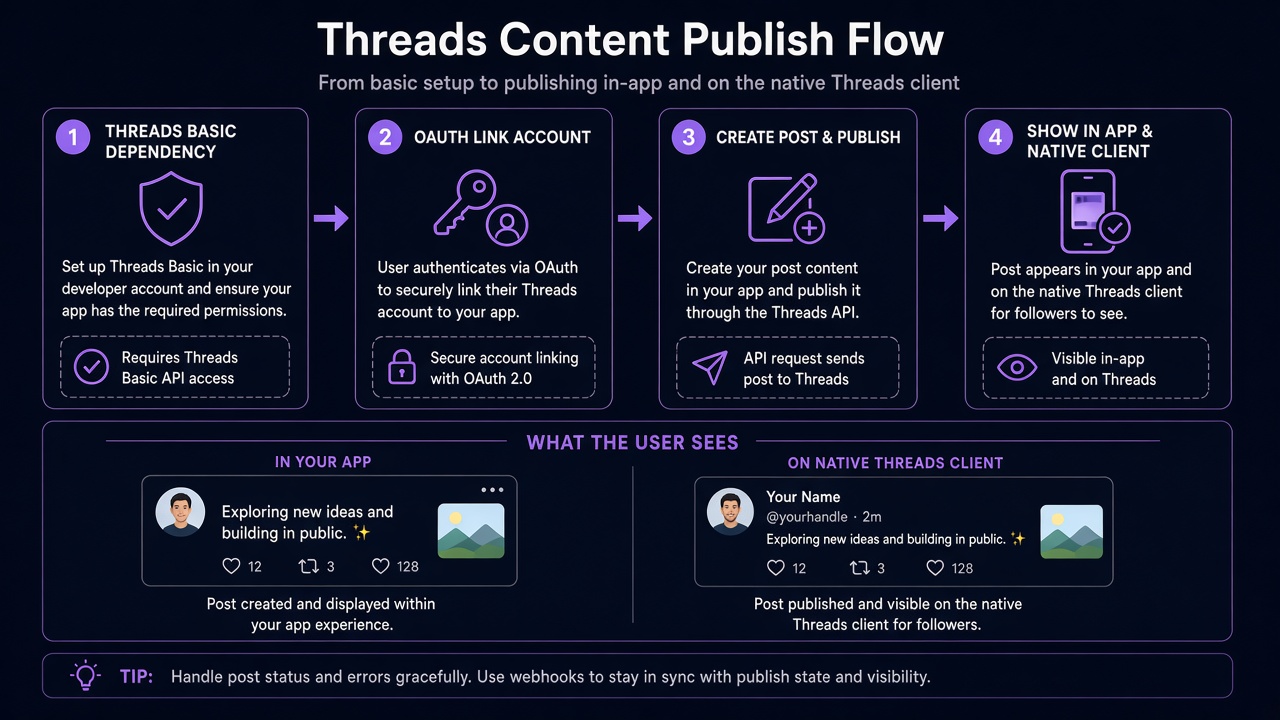
Official dependency: threads_basic
threads_basic is required. Metas allowed usage for it is displaying a users own Threads posts within an app for managing presence (visible to that user). Its screencast bar includes Threads OAuth, linking the account, and retrieving the users own posts with text/images/videos. In a threads_content_publish package, treat threads_basic as the profile/posts foundation that makes publish coherent not as an unrelated bonus scope.
If you only need to display a users Threads posts and never publish, reconsider whether you should be requesting threads_content_publish at all. Scope honesty beats a dual request with a single surface.
Common demo gaps
- Test Threads account that cannot complete OAuth with the credentials you supplied.
- Screencast that skips permission prompt screens during account linking.
- Publish that only works on a production deep link reviewers cannot reach.
- Showing media upload progress without ever opening native Threads to confirm the post.
- Notes that paste Instagram Graph publishing language into a Threads permission form.
These are diagnosis categories, not a secret approve script. Token models and composer UX differ; specialists identify which step in Metas official screencast chain broke for your build, then rebuild proof once.
threads_content_publish vs adjacent rejection labels
Threads publish denials often arrive as inadequate demonstration or unable to verify permissions while the distinctive miss is incomplete OAuth create publish native Threads proof. Approving threads_basic alone does not carry publish. An Instagram content publish approval does not carry Threads. Keep the evidence map honest to Meta’s table for threads_content_publish: Threads OAuth, account link, compose with text/media, publish, and dual-surface confirmation.
7-day cooldown risk: Teams often resubmit after swapping an Instagram publish clip or rewriting we help creators post to Threads copy while Threads OAuth native delivery proof remains missing. Those blind retries fail and can trigger App Review submission cooldowns of up to about 7 days.
When a specialist audit helps
Audit help is high leverage when you previously filed under a vague Threads API” narrative, when Instagram and Threads packages were mixed, when threads_basic is green but publish stays red (or both stay red), or when OAuth linking works for founders but not for Test Users. The specialist maps Metas official screencast chain to your product and decides whether to keep, split, or drop scopes — without a fake universal recording template.
Need Us to Get Your Meta App 100% Approved?
Stop losing weeks to repeated rejections. With 500+ apps approved, we handle your entire submission from start to finish. You get 100% Approval or a 100% Refund — and for your complete safety, you can hire us directly through Upwork or Fiverr Escrow (or use the WhatsApp / Calendar buttons in the header & footer).
Chat on WhatsAppFAQ
What is threads_content_publish used for?
Per Meta, it lets a business app create and publish content on behalf of a Threads profile so users can manage their Threads presence. Official dependency: threads_basic.
What must the screencast show?
Threads OAuth grant, full account linking with requested permissions visible, create a post with text/images/videos, publish, and show results in your app and the native Threads app.
Is this the same as Instagram content publish?
No. instagram_content_publish is a separate permission and Login/surface stack. Do not substitute Instagram demos for threads_content_publish.
Can blind Threads publish resubmits cause cooldowns?
Yes. Cosmetic or Instagram-substituted retries that leave OAuth publish → native proof unrecreateable often fail again and can lock App Review for multiple days.