Incentivizing unapproved actions is the core Meta App Review risk this guide diagnoses.
For teams facing an incentivizing unapproved actions rejection, this diagnosis turns policy language into a clean remediation plan.
The safest resubmission removes every incentivizing unapproved actions loop before reviewers test the flow again.
Document each incentivizing unapproved actions fix before submitting so the review path is easy to verify.
A documented incentivizing unapproved actions correction helps reviewers validate the redesign quickly.
Meta App Review RejectionYour App Incentivizes Unapproved Actions: Expert Diagnosis
When Meta App Review returns Your app incentivizes unapproved actions, especially on Instagram-facing products, reviewers are not asking you to polish onboarding copy. They are flagging reward systems that push users to perform Instagram actions — likes, follows, shares, and similar promotions — in exchange for points, unlocks, credits, or other in-app benefits. This article grounds that rejection in Meta’s App Review Rejection Guide and Instagram Platform Policy A.30, explains why growth/engagement tools trip it often, and why hiding the reward behind a soft “optional tip” still fails on blind resubmit.
What this rejection actually means
Meta’s Rejection Guide states:
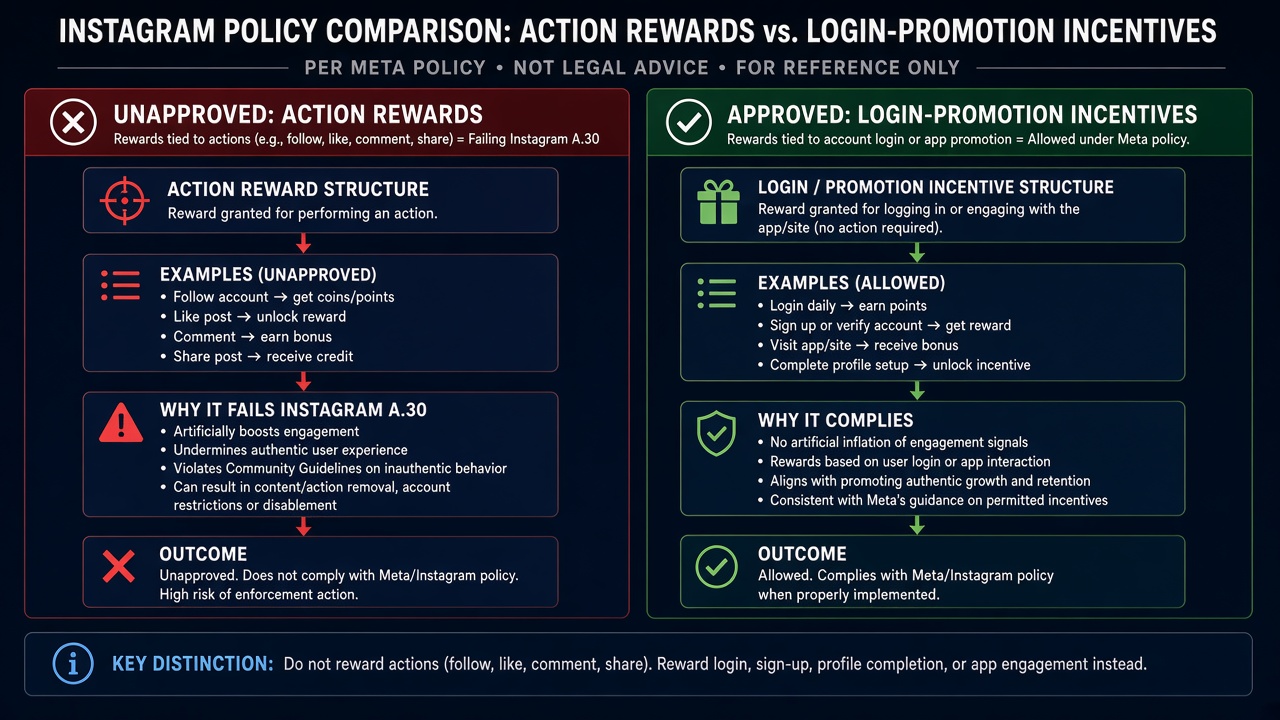
Submissions for apps that incentive app users to promote those apps through the use of Instagram actions such as likes and follows will be rejected with “Your app incentivizes unapproved actions”. Section A.30 of Instagram’s Platform Policy prohibits in-app reward systems for sharing to Instagram:
“Only incentivize a person to log into your app or enter a promotion. Don’t incentivize other actions.”
If your app has been rejected for this reason, remove any functionality that incentivizes your users to promote your app or your brand through Instagram actions before resubmitting.
That is the entire remediation path in the guide: remove the incentivizing functionality — not rename it, not move it to a webview, not claim it is educational. Neighboring policy pressure often co-travels with Disallowed Use Case Details, Developer Policy 1.7 (misleading growth claims), and generic wrappers like Unable to Approve Permission Request when Instagram scopes sit on top of a reward loop.
WHAT failed
The app rewards users for Instagram actions (likes, follows, shares, brand/app promotion) beyond the narrow A.30 exceptions.
WHY it matters
Incentivized engagement manipulates the Instagram graph and user trust. Meta treats it as a platform-integrity failure, not a growth hack.
WHAT they expected
No reward loop for Instagram actions. Incentives — if any — limited to logging into your app or entering a promotion, per A.30.
Reviewer psychology: rewards poison the graph
Instagram App Review looks for cause-and-effect: do something on Instagram → get something in the app. Points for following creators, credits for liking posts, unlocks for tagging the brand, leaderboards for “engagement challenges,” or “get free reports after you share to Stories” all read as incentivized unapproved actions. Reviewers do not need a legal memorandum; a visible exchange is enough.
Analytics, scheduling, growth, and engagement-tool SaaS products hit this rejection disproportionately because business models historically leaned on manufactured engagement. Even if your primary pitch is “insights,” a secondary gamification layer that pays users for follows will dominate the policy read. Softening language (“suggested community actions”) while keeping the reward ledger usually fails — Meta evaluates the live loop, not the euphemism. That overlaps final UX mismatch when the screencast hides the reward screen reviewers later find.
Technical nuances that trip capable teams
Across hundreds of Instagram / Meta apps, A.30-style failures cluster around:
- Follow-for-credits / like-for-points — explicit ledgers tying Instagram actions to in-app currency.
- Share-to-unlock — gating features behind Stories/Feed shares that promote the app or brand.
- “Promotion” that is not a promotion — calling every reward a promotion while it actually pays for likes/follows (A.30 allows incentivizing login or entering a promotion — not other actions).
- Creator marketplaces with engagement bounties — paying or scoring users for Instagram graph actions inside the product.
- Hidden webviews — moving the reward UI off the native shell while the same loop remains reachable after Login.
- Screencast scrubbing — demo skips the rewards tab; reviewers still find it via navigation (also adjacent to Inadequate Demonstration).
- Brand naming that promises growth hacks — packaging that implies Instagram engagement farms, compounding Policy 1.7 risk.
Official references:
- Meta App Review Rejection Guide — “Your app incentivizes unapproved actions” / Instagram A.30 quote
- Instagram Platform Policy section A.30 — only incentivize login or entering a promotion; don’t incentivize other actions
- Meta Developer Policies — trustworthy product; do not spam or manipulate
Blind resubmission risk: Practitioner experience across hundreds of apps shows teams often “fix” this rejection by renaming points to “badges,” moving the reward screen behind a toggle, or claiming the feature is optional — while the exchange (Instagram action → benefit) remains. Those retries fail A.30 again and frequently contribute to automated submission cooldowns that can lock App Review buttons for up to 7 days. Remove the incentivizing functionality once; do not burn cycles on cosmetic camouflage.
Expert Diagnosis framework (not a DIY paste template)
Every growth product and creator marketplace is unique. There is no safe universal “approved rewards wording.” Specialists diagnose first:
Inventory every Instagram-action → benefit link
Credits, unlocks, rankings, discounts, free tiers — if an Instagram like/follow/share triggers value in-app, it is on the A.30 radar.
Separate legitimate promotions from action bounties
A.30 allows incentivizing login or entering a promotion. It does not allow paying for other Instagram actions. Redesign or delete the bounty layer.
Align product, marketing, and screencast
Remove reward UI from production/test builds reviewers can reach. Do not ship a “clean” video of a dirty app.
Resubmit once after removal is real
One coherent, A.30-clean package beats three camouflage retries that invite cooldowns.
Managed help: Facebook App Review service. Patterns: case studies. Related: Human Agent Permission, PPCA not needed, rejection reasons hub.
Free 15-Minute Meta Rejection Audit
Share your rejection note, a screenshot of any rewards/points screen, and whether Instagram likes or follows grant in-app value. We will map the loop to A.30 before you burn another review cycle.
Strategy second.
What not to do after this rejection
- Do not rename points to badges while keeping the same Instagram-action exchange.
- Do not hide the reward UI only in the screencast; reviewers navigate the live app.
- Do not claim every bounty is a “promotion” if users are paid for likes and follows.
- Do not resubmit Instagram scopes on top of an unchanged engagement farm.
Remove the incentivizing functionality. Keep only A.30-safe incentives if any. Then submit once.
Need Us to Get Your Meta App 100% Approved?
Stop losing weeks to repeated rejections. With 500+ apps approved, we handle your entire submission from start to finish. You get 100% Approval or a 100% Refund — and for your complete safety, you can hire us directly through Upwork or Fiverr Escrow (or use the WhatsApp / Calendar buttons in the header & footer).
Chat on WhatsAppFAQ
What does “Your app incentivizes unapproved actions” mean?
Per Meta’s Rejection Guide, apps that incentivize users to promote the app through Instagram actions such as likes and follows are rejected with this message. Instagram Platform Policy A.30 prohibits in-app reward systems for sharing to Instagram beyond narrow exceptions.
What does Instagram A.30 allow?
A.30 states: “Only incentivize a person to log into your app or enter a promotion. Don’t incentivize other actions.” Rewarding likes, follows, or other Instagram graph actions for in-app benefits falls outside that line.
Will making the reward optional fix the rejection?
Usually not. If the product still offers value in exchange for Instagram actions, reviewers treat it as incentivizing unapproved actions. The Rejection Guide remediation is to remove the incentivizing functionality before resubmitting.
Do blind resubmits after an A.30 rejection risk cooldowns?
Yes. Cosmetic renames or hidden toggles without removing the reward loop often fail again, and rapid retries can lock App Review submission controls for up to 7 days.
Amandeep Singh — Meta API Expert
10+ years helping product teams through Meta App Review, Business Verification, and Advanced Access. 500+ apps guided; 10,000+ permissions handled across Facebook, Instagram, WhatsApp, and Marketing API surfaces. Focus: policy-aligned proof, not hype.
Still stuck on incentivizing unapproved actions? Get a focused read on your rejection before the next submit.
Book Free 15-Minute Meta Rejection Audit on WhatsApp